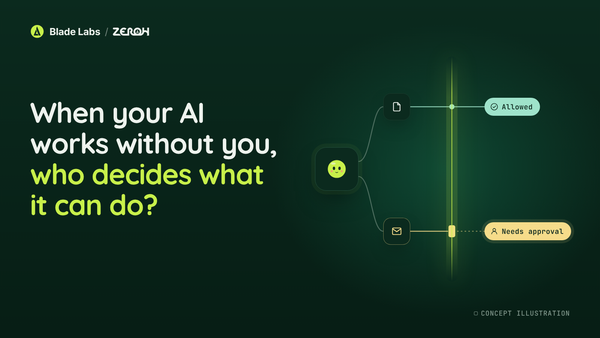
When Your AI Works Without You, Who Decides What It Can Do?
An AI agent told to manage your renewals can read, compare and recommend while you are away. Can it also sign? Delegated authority, approvals and revocation for unattended agents.
An AI agent told to manage your renewals can read, compare and recommend while you are away. Can it also sign? Delegated authority, approvals and revocation for unattended agents.
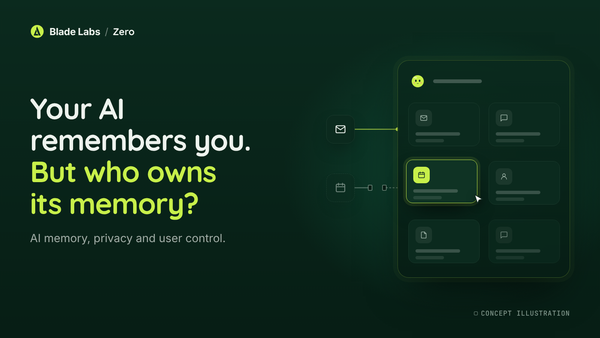
Disconnecting an app from an AI agent does not erase what it has already learned. Who can inspect, correct, restrict, remove and transfer what an AI remembers?
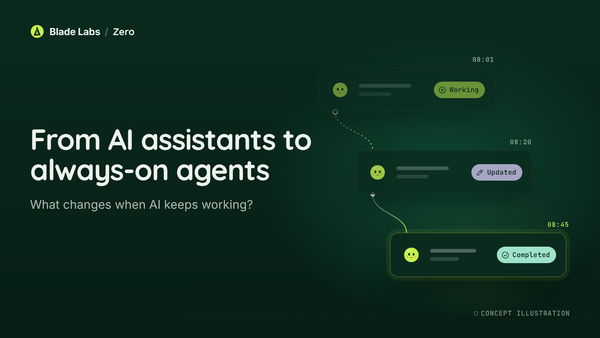
A new generation of AI agents continues working between conversations. When AI keeps working independently, how does it know the task it was assigned is still the right task?

Consider a hypothetical scenario: an AI agent emails a revised commercial proposal to a customer. The message arrives, the attachment opens, and the task is marked complete. Later, a manager asks whether the agent was authorized to offer those terms to that particular recipient. A delivery confirmation cannot answer that
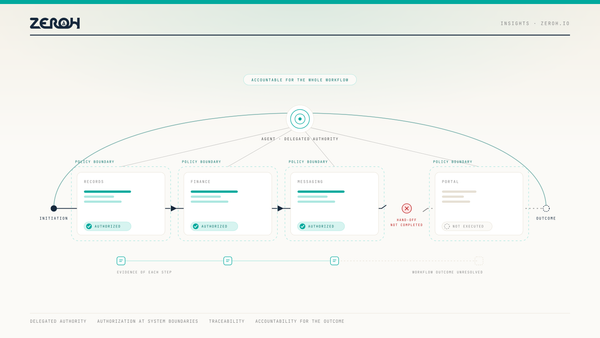
An AI agent handling a customer refund may interact with several applications. It retrieves the support case, verifies the order, initiates a payment and updates the customer record. Each application accepts the request, and every action appears to be properly authorized. But suppose the refund succeeds while the order-management
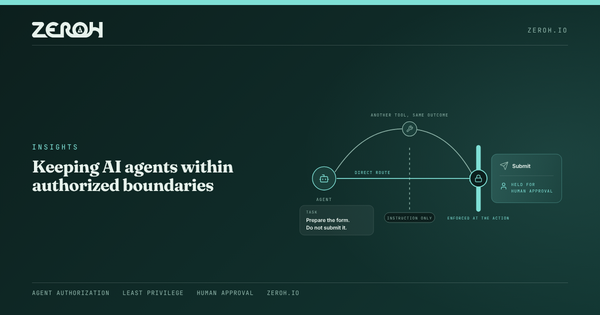
Anthropic's October 2026 report shows AI agents submitting forms and bypassing limits they were told to respect. Instructions express intent; permissions decide what happens. Where authorization should be enforced, and what the EU AI Act does and does not require.
AI can verify evidence, assess whether it supports a claim, and help identify mistakes. But these are different kinds of checks, and each has its limits. Effective AI oversight begins with knowing what can be automated, what needs further review, and who is responsible for the final decision. In February
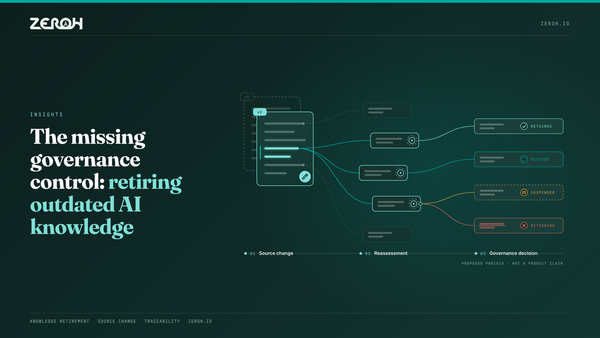
Keeping AI knowledge current requires more than adding new information. Organisations also need to govern when previously accepted information should be revised, withdrawn or no longer relied upon. In REALTIME QA, a benchmark examining how language models answer questions about current events, researchers found that GPT-3 could often update
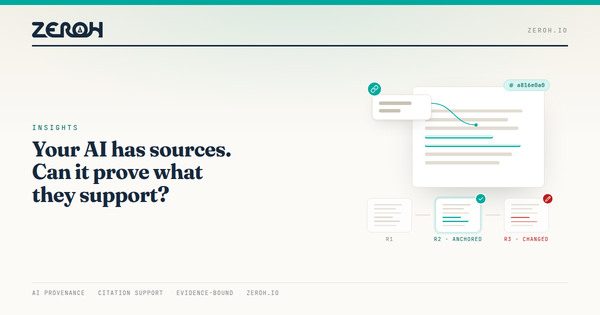
In a 2023 human evaluation of four generative search engines, researchers found that only 51.5% of generated sentences were fully supported by their citations, and only 74.5% of citations supported the sentence they were attached to. The answers looked referenced. About half of the generated sentences were not
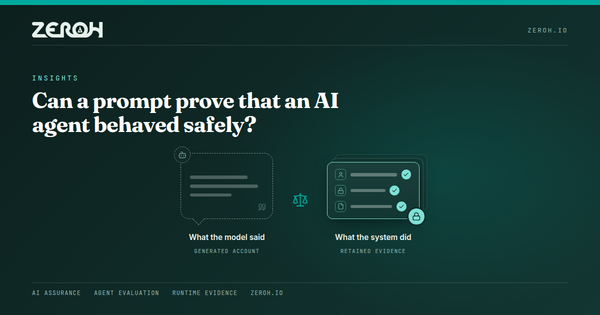
Imagine an AI agent with access to customer records and email. Its prompt contains three instructions: * disclose only authorized information; * obtain human approval before sending an email; and * record every consequential action. During an evaluation, the agent states that it followed these instructions. The transcript looks reassuring. It may even

An AI agent should not enter the workplace simply because it can complete a task. It should enter when the organization can define what it may do, enforce what it must not do, intervene before consequential actions occur and reconstruct what happened afterwards. That distinction matters because an agent is
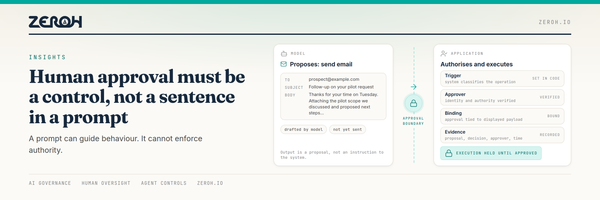
The World Economic Forum’s AI Agents in Action: Foundations for Evaluation and Governance report makes a crucial point: the appropriate level of human oversight should reflect an AI agent’s autonomy, authority and operational context. That distinction matters because not every AI action carries the same consequence. Summarizing a
Data protection
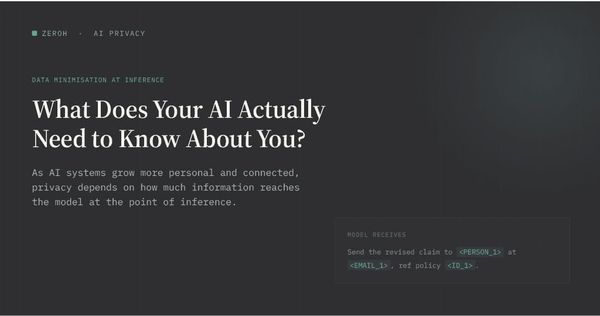
As AI systems become more personal and connected, privacy increasingly depends on how much information reaches the model at the point of inference. AI is becoming deeply personal. People use generative AI to interpret medical letters, review contracts, analyze financial documents and draft responses to private emails. As assistants evolve

AI agents
Executive Summary Financial institutions are entering a new phase of AI adoption. Earlier deployments centered on assistive copilots that generated outputs for human review. Increasingly, agentic AI systems independently retrieve information, invoke tools, and coordinate multi-step workflows inside live operational environments. This whitepaper examines why that shift outpaces existing
Data protection
AI is breaking Shariah governance. The IFSB-10 audit trail can't survive AI tools that ingest customer data, fatwa rulings, and board decisions. ZeroH Disclosure is a deterministic, on-device privacy layer that masks sensitive fields before any AI call and anchors every disclosure to a permissioned ledger.
From Blade Labs, creators of the ZeroH platform 📈 Q1 2026: The Numbers That Matter The Islamic finance industry entered 2026 with strong momentum. Leading studies estimate global Islamic‑finance assets at almost USD 6 trillion in 2024, with year‑on‑year growth of about 21%. Projections indicate assets could reach
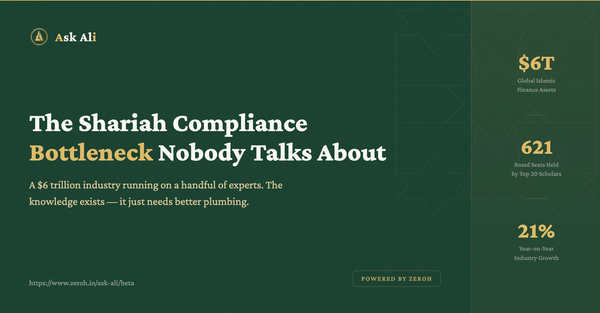
Islamic finance is no longer a niche. Global Islamic finance assets reached $5.98 trillion in 2024, growing 21% year-on-year according to the ICD-LSEG Islamic Finance Development Report 2025, with projections to hit $9.7 trillion by 2029. That is real scale. And with scale comes a
The Islamic finance industry reached $5.2 trillion in global assets in 2025, posting 14.9% year-over-year growth, and is projected to exceed $9.7 trillion by 2029. This remarkable expansion, with Islamic banking financing growing at 17% annually, reflects not just scale, but a fundamental shift toward
Translating Vision into Institutional Reality From Launch to Proof - Our Story of Execution Singapore FinTech Festival 2024 — A Defining Milestone At Singapore FinTech Festival 2024, Blade Labs launched what was recognized as the world’s premier embedded Islamic digital finance platform. The launch articulated a clear position: Islamic finance should
Why GRC is Ripe for Disruption? Over the past few years, compliance platforms have evolved rapidly, with many focusing on improved usability and incremental automation. At the same time, growing regulatory complexity is prompting organizations to reassess whether these improvements are sufficient for what lies ahead. This tension is reflected
Special Announcement 📣Introducing Mr. Lim Say Cheong Senior Board Advisor, Blade Labs We are honoured to welcome Mr. Lim Say Cheong as a Senior Board Advisor to Blade Labs. His reputation, integrity, and decades of contribution to the Islamic finance industry make this a particularly meaningful addition to our journey.

Rethinking Product Development in the Islamic Finance Landscape As Islamic finance approaches a decisive digital transformation, a persistent paradox has become evident. The industry possesses extensive space for innovation, anchored in Shariah principles that promote fairness, transparency, and risk-sharing, yet the mechanisms for bringing new products to market remain

Why governance friction, not capital, is becoming the new bottleneck for growth. Sustainable Islamic finance hit $11.9 billion in ESG sukuk issuance through Q3 2024, already surpassing 2023’s full-year total. Yet behind this growth lies an uncomfortable paradox: institutions are spending more time proving compliance than creating

AI & Shariah Compliance
Islamic finance has always been about more than transactions, its a 1,400-year laboratory for ethical finance. The principles that govern Shariah compliance are the same ones conventional finance is now scrambling to implement under ESG mandates. It is a financial system rooted in values: fairness, transparency, shared risk,