[TEST — DRAFT ONLY] Ghost cover and inline ed4445d0
This is an internal delivery check. Do not publish. Image placement The prepared article retains its cover and inline image. * Draft only * Human scheduling remains a separate action
An AI agent should not enter the workplace simply because it can complete a task. It should enter when the organization can define what it may do, enforce what it must not do, intervene before consequential actions occur and reconstruct what happened afterwards. That distinction matters because an agent is
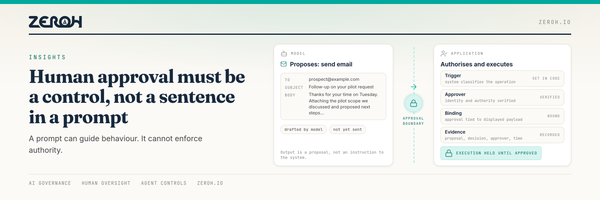
The World Economic Forum’s AI Agents in Action: Foundations for Evaluation and Governance report makes a crucial point: the appropriate level of human oversight should reflect an AI agent’s autonomy, authority and operational context. That distinction matters because not every AI action carries the same consequence. Summarizing a
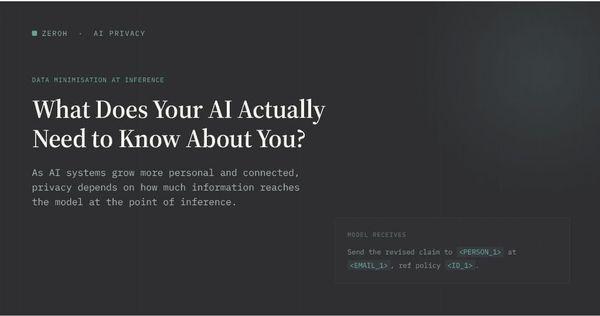
As AI systems become more personal and connected, privacy increasingly depends on how much information reaches the model at the point of inference. AI is becoming deeply personal. People use generative AI to interpret medical letters, review contracts, analyze financial documents and draft responses to private emails. As assistants evolve
Executive Summary Financial institutions are entering a new phase of AI adoption. Earlier deployments centered on assistive copilots that generated outputs for human review. Increasingly, agentic AI systems independently retrieve information, invoke tools, and coordinate multi-step workflows inside live operational environments. This whitepaper examines why that shift outpaces existing
AI is breaking Shariah governance. The IFSB-10 audit trail can't survive AI tools that ingest customer data, fatwa rulings, and board decisions. ZeroH Disclosure is a deterministic, on-device privacy layer that masks sensitive fields before any AI call and anchors every disclosure to a permissioned ledger.
From Blade Labs, creators of the ZeroH platform 📈 Q1 2026: The Numbers That Matter The Islamic finance industry entered 2026 with strong momentum. Leading studies estimate global Islamic‑finance assets at almost USD 6 trillion in 2024, with year‑on‑year growth of about 21%. Projections indicate assets could reach
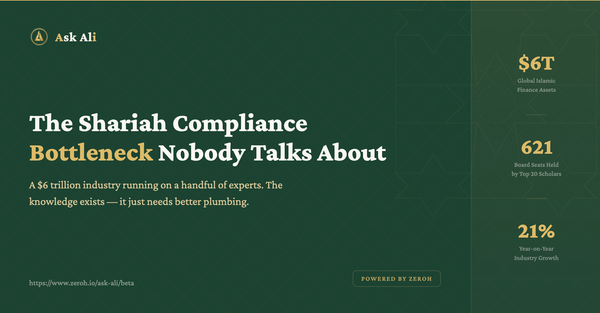
Islamic finance is no longer a niche. Global Islamic finance assets reached $5.98 trillion in 2024, growing 21% year-on-year according to the ICD-LSEG Islamic Finance Development Report 2025, with projections to hit $9.7 trillion by 2029. That is real scale. And with scale comes a
The Islamic finance industry reached $5.2 trillion in global assets in 2025, posting 14.9% year-over-year growth, and is projected to exceed $9.7 trillion by 2029. This remarkable expansion, with Islamic banking financing growing at 17% annually, reflects not just scale, but a fundamental shift toward
Translating Vision into Institutional Reality From Launch to Proof - Our Story of Execution Singapore FinTech Festival 2024 — A Defining Milestone At Singapore FinTech Festival 2024, Blade Labs launched what was recognized as the world’s premier embedded Islamic digital finance platform. The launch articulated a clear position: Islamic finance should
Why GRC is Ripe for Disruption? Over the past few years, compliance platforms have evolved rapidly, with many focusing on improved usability and incremental automation. At the same time, growing regulatory complexity is prompting organizations to reassess whether these improvements are sufficient for what lies ahead. This tension is reflected
Special Announcement 📣Introducing Mr. Lim Say Cheong Senior Board Advisor, Blade Labs We are honoured to welcome Mr. Lim Say Cheong as a Senior Board Advisor to Blade Labs. His reputation, integrity, and decades of contribution to the Islamic finance industry make this a particularly meaningful addition to our journey.