[TEST — DRAFT ONLY] Ghost cover and inline ed4445d0

This is an internal delivery check. Do not publish.

Image placement
The prepared article retains its cover and inline image.
- Draft only
- Human scheduling remains a separate action
This is an internal delivery check. Do not publish.
The prepared article retains its cover and inline image.

An AI agent should not enter the workplace simply because it can complete a task. It should enter when the organization can define what it may do, enforce what it must not do, intervene before consequential actions occur and reconstruct what happened afterwards. That distinction matters because an agent is
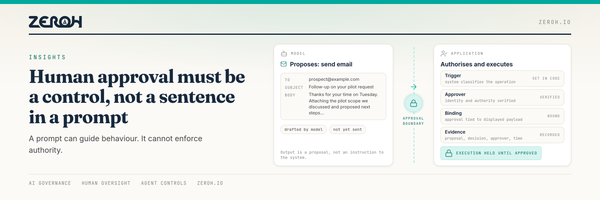
The World Economic Forum’s AI Agents in Action: Foundations for Evaluation and Governance report makes a crucial point: the appropriate level of human oversight should reflect an AI agent’s autonomy, authority and operational context. That distinction matters because not every AI action carries the same consequence. Summarizing a
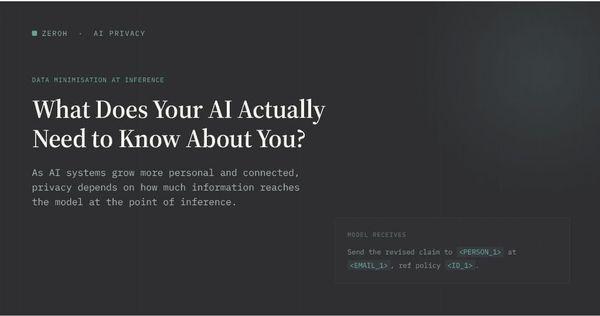
As AI systems become more personal and connected, privacy increasingly depends on how much information reaches the model at the point of inference. AI is becoming deeply personal. People use generative AI to interpret medical letters, review contracts, analyze financial documents and draft responses to private emails. As assistants evolve

Executive Summary Financial institutions are entering a new phase of AI adoption. Earlier deployments centered on assistive copilots that generated outputs for human review. Increasingly, agentic AI systems independently retrieve information, invoke tools, and coordinate multi-step workflows inside live operational environments. This whitepaper examines why that shift outpaces existing