Why Authentic Islamic Finance Should Be Faster. And Can Be.
Rethinking Product Development in the Islamic Finance Landscape
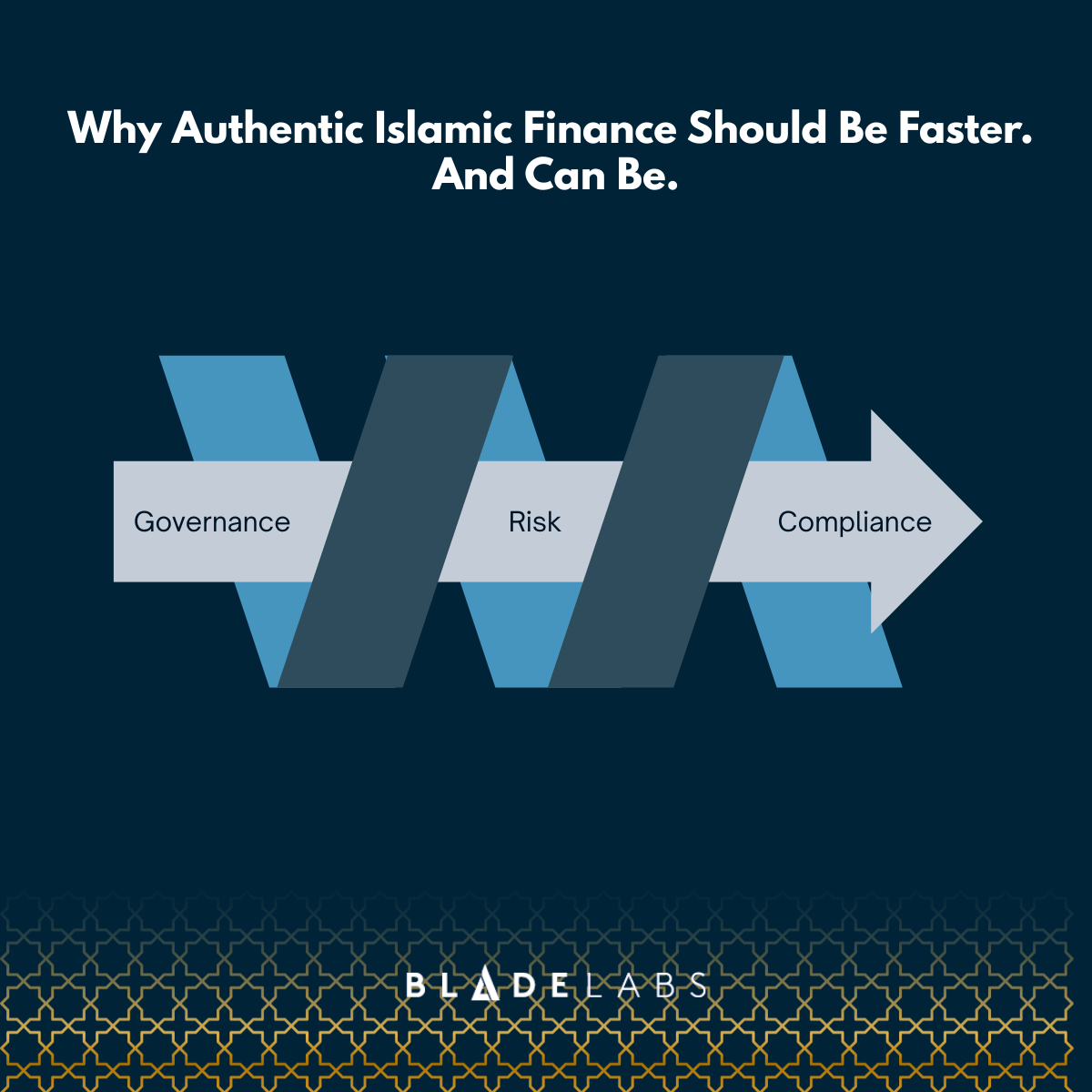
As Islamic finance approaches a decisive digital transformation, a persistent paradox has become evident. The industry possesses extensive space for innovation, anchored in Shariah principles that promote fairness, transparency, and risk-sharing, yet the mechanisms for bringing new products to market remain slow, fragmented, and operationally fragile. The bottleneck is clear: lengthy, multi-layered product development cycles that undermine competitiveness in markets where demand and regulation shift rapidly. At its core, this is a GRC challenge: governance structures designed for oversight have become bottlenecks, risk management remains reactive, and compliance workflows lack the automation needed for modern financial markets.
This raises a fundamental question: How can Islamic finance innovate with authenticity while avoiding the inertia that has historically constrained it?
The GRC Bottleneck: Structural Complexity Behind Slow Product Cycles
Developing an Islamic financial product is inherently more complex than its conventional counterpart. Beyond standard regulatory approvals, each structure must satisfy Shariah requirements that demand:
• demonstrable asset linkage,
• elimination of riba, gharar, and prohibited elements,
• alignment with AAOIFI and IFSB standards,
• Shariah board review governed by formal institutional processes and statutory fiduciary obligations.
A typical product initiative involves coordination across at least seven functions - product, legal, Shariah, IT, compliance, risk, and treasury. But the friction is not merely operational; it is institutional.
Shariah oversight is too often integrated late in the development process, leading to document rework, interpretive ambiguity, sequencing delays, and inconsistent version control. This is exacerbated by fragmented documentation practices, absence of unified templates, and non-standardized review cycles.These are classic governance and compliance gaps, symptoms of GRC infrastructure that has not evolved alongside digital-banking expectations.
None of these constraints are arbitrary, they are part of the governance fabric of the industry. However, the way they are managed today introduces unnecessary delay and operational risk, which digital transformation can and should address.
The True Cost of Delay: Strategic, Not Just Financial
In modern financial markets, time-to-market is a competitive determinant. Prolonged product development cycles directly result in:
• delayed revenue recognition,
• slower market capture,
• reduced responsiveness to regulatory changes,
• loss of competitive relevance.
Moreover, recurring perceptions that Islamic financial products merely replicate conventional structures compound the challenge. When Islamic products take significantly longer to launch yet appear substantively similar, the industry risks reinforcing the narrative that it is slow, reactive, and insufficiently innovative.
If Islamic finance aims to lead in ethical and impact-aligned finance, it must demonstrate that authenticity can coexist with agility - and that its governance requirements can be met without obstructing strategic responsiveness.
From a GRC perspective, these delays represent compounding risk: operational risk from manual handoffs, compliance risk from version-control failures, reputational risk from perceived inauthenticity, and strategic risk from competitive disadvantage. Traditional risk-management frameworks treat these as isolated issues; modern GRC thinking recognizes them as interconnected workflow failures.
A New Paradigm: GRC-Integrated “Shariah-From-Day-One” Workflows
Achieving this transformation requires rethinking the existing workflows.
An enterprise-wide, AI-orchestrated product development system can establish a Shariah-from-day-one model where:
- Shariah rulesets and standards are embedded into templates,
- documentation is auto-checked for compliance with AAOIFI/IFSB requirements,
- legal, risk, and consumer-protection considerations surface early,
- version control is governed by a single audit-secure pipeline,
- scholars receive structured, traceable submissions rather than fragmented drafts.
- GRC controls are embedded at each stage, creating continuous compliance rather than checkpoint-based governance.
Under such a workflow, documentation timelines that traditionally take months can be compressed to weeks, with a significant portion of compliance and Shariah checks completed before formal review. This preserves and strengthens scholarly oversight by eliminating avoidable human coordination friction and transforming GRC from a compliance checkpoint into an enabler of speed and authenticity.
Digital banks and Islamic windows stand to benefit most, as they operate cleaner technology stacks and can integrate workflow-based compliance logic across the product lifecycle.
The Jurisdictional Opportunity
Across established Islamic-finance hubs such as the GCC and Malaysia, regulators are actively driving digitalization, yet institutions still grapple with governance burden, documentation intensity, and multi-layered approvals. These markets demonstrate the broader pattern: the constraint is no longer conceptual innovation but GRC workflow execution—the ability to embed governance, manage regulatory risk, and automate compliance at scale.
Against this backdrop, Kazakhstan and Bangladesh illustrate why modern workflow infrastructure is urgently needed. Kazakhstan is reforming its banking and fintech regulations and expanding Islamic finance through digital sandboxes and regulatory modernisation. However, it suffers from limited product supply and scarce Shariah expertise, creating governance-capacity constraints that slow sector growth. Workflow-orchestrated product development directly addresses these constraints by standardizing templates, embedding AAOIFI-aligned logic, and reducing reliance on a small expert pool.
Bangladesh, meanwhile, has a large Islamic banking base but limited diversification due to voluntary Shariah governance, documentation-heavy processes that expose compliance gaps, and incomplete Islamic-finance legislation. The value here lies in scalability: automated Shariah checks, version control, and governance triggers would allow banks to introduce new products without overwhelming their existing teams.
Across all four jurisdictions, the conclusion is the same: demand for Shariah-compliant offerings is rising, but product development remains constrained by governance friction—precisely the gap a configurable, GRC-integrated Shariah workflow platform is built to close.
The Path Forward: Speed With Integrity
Islamic finance is well positioned to lead the next era of global ethical finance, but only if it modernizes its product development architecture. This is not a choice between authenticity and speed, it is a GRC transformation challenge. Authenticity without operational agility limits market impact; agility without Shariah integrity is untenable. Modern GRC infrastructure makes both possible.
By embracing GRC-integrated workflow automation, early-stage Shariah integration, and AI-assisted compliance reasoning, the industry can move beyond duplication and set a new standard for governance-driven, principled innovation. The choice is clear: continue mimicking conventional models, or build the infrastructure that allows Islamic finance to innovate on its own terms. With the right foundations in place, Islamic finance can evolve into a model of ethical, efficient, and innovation-driven financial practice.