Issue 7: Beyond Compliance Islamic Fintech in Action | Q1 2026
From Blade Labs, creators of the ZeroH platform
📈 Q1 2026: The Numbers That Matter
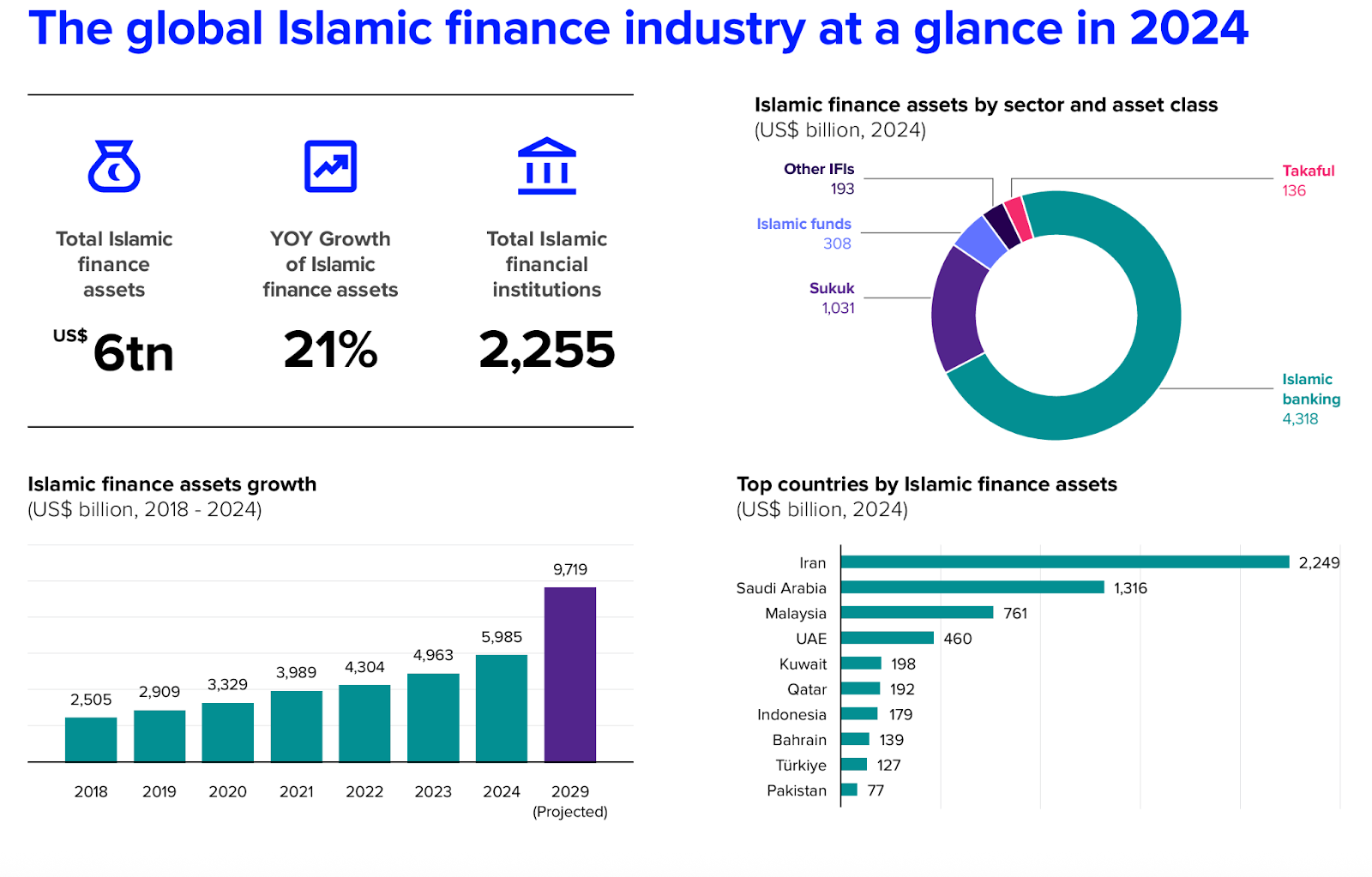
The Islamic finance industry entered 2026 with strong momentum. Leading studies estimate global Islamic‑finance assets at almost USD 6 trillion in 2024, with year‑on‑year growth of about 21%. Projections indicate assets could reach about USD 9.7 trillion by 2029, growing at an average annual rate of roughly 10%. Islamic‑banking financing showed particularly rapid expansion in 2025, with some sources reporting financing growth above 17% that year
But here is the tension beneath those numbers.The global financial crime compliance spend stands at $206 billion. Compliance operating costs have risen over 60% since the 2008 financial crisis. The RegTech market, valued at $19 to $24 billion, still largely overlooks Islamic finance. The gap between the industry's scale and its compliance infrastructure has never been wider.And if innovation does not close that gap, growth alone will not protect the industry from the risks that come with it.
📖 A Regulatory Signal Worth Watching: Malaysia's Capital Market Masterplan 2026 to 2030
This quarter, Malaysia's Securities Commission published its Capital Market Masterplan 2026 to 2030, and its implications stretch well beyond Malaysia's borders.Consider the context: Malaysia's Islamic Capital Market is valued at RM2.7 trillion, representing 64% of the country's total capital market. Malaysia has ranked first on the ICD-LSEG Islamic Finance Development Indicator for 13 consecutive years and remains the world's largest sukuk issuer. When Malaysia's regulator charts a direction, the global industry pays attention.The most important shift in the Masterplan? A move beyond Shariah compliance toward Maqasid al-Shariah as the guiding compass for capital market development.
Key highlights from the Masterplan:
- From compliance to impact. Financial activities must now align with the broader Maqasid al-Shariah, not just meet Shariah compliance standards. The vision is anchored in Halal-Toyyib: Islamic finance must be wholesome, not just compliant, focused on tangible societal benefit over replication of conventional products.
- Six Maqasid aspirations for the ICM. The SC outlines six aspirations: Humanity, Justice and Benevolence, Clarity and Transparency, Flexibility and Innovation, Fiduciary and Accountability, and Accessibility and Inclusivity, anchored by 15 guiding principles.
- Measurable Maqasid indicators. The SC will develop indicators to help investors identify ethical assets with greater confidence, moving Maqasid from principle into practice.
- AI-based Shariah screening tools. The Masterplan calls for AI-powered digital tools to screen public information for Shariah compliance across jurisdictions at scale.
- Next-generation Shariah leadership. A new Super Scholar programme will develop multi-disciplinary Shariah leaders spanning finance, sustainability, governance, and innovation, directly addressing the scholar concentration challenge.
This Masterplan validates the direction Blade Labs has been building toward since day one. Our ZeroH platform is designed to align with Maqasid al-Shariah principles, ensuring that the products, workflows, and governance structures we support deliver on the higher objectives of Shariah and contribute to real capacity building across the industry.
📣 Announcing: The Islamic Finance Compliance Checklist
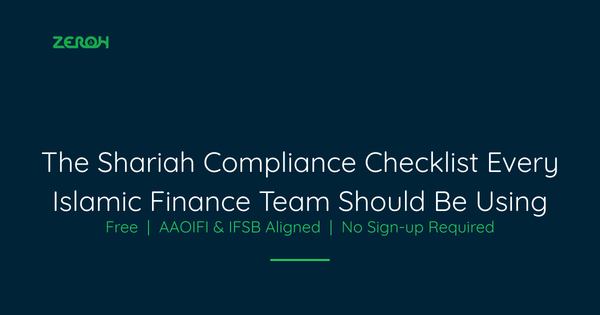
This quarter, we launched the ZeroH Islamic Finance Compliance Checklist, a free, interactive, 81-point tool aligned to AAOIFI and IFSB standards. No sign-up required.
The problem it solves: products routinely reach the Shariah Supervisory Board with structural gaps that should have been caught at the design stage, leading to rejection and rework cycles stretching to six months. Research shows 40 to 60% of SSB review time is spent searching for precedents, not evaluating structures. That is a preparation problem, not a scholarship problem.
The checklist covers five pillars:
- Shariah Governance Framework (19 items)
- Product Shariah Compliance (25 items)
- Regulatory & Operational Compliance (15 items)
- Audit Readiness (14 items)
- ESG & Sustainability Integration (8 items), including Maqasid al-Shariah and UN SDG alignment
Teams can track their compliance score in real time and download a PDF for offline SSB preparation.
Try it now → zeroh.io/resources/islamic-finance-compliance-checklist
📣 Announcing: Ask Ali (Early Access)
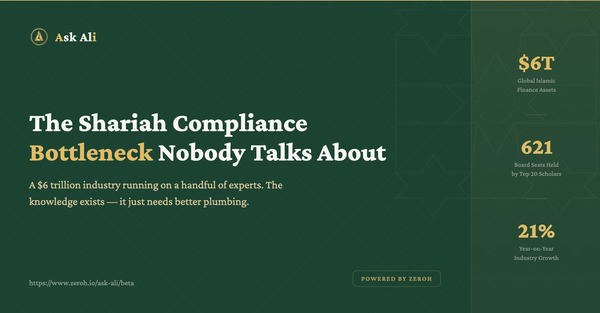
This quarter, we opened early access to Ask Ali, a Shariah compliance research tool built to address the scholar concentration problem: just 20 scholars once held 621 board memberships across 370+ institutions, and more recent data shows the bottleneck has not eased. A single product review can take weeks, with most of that time spent on information retrieval, not scholarly reasoning.
Ask Ali does not issue fatwas. It does not replace scholars. What it does:
- Surfaces the relevant AAOIFI standard for any given question
- Presents scholarly opinions across all four madhahib side by side
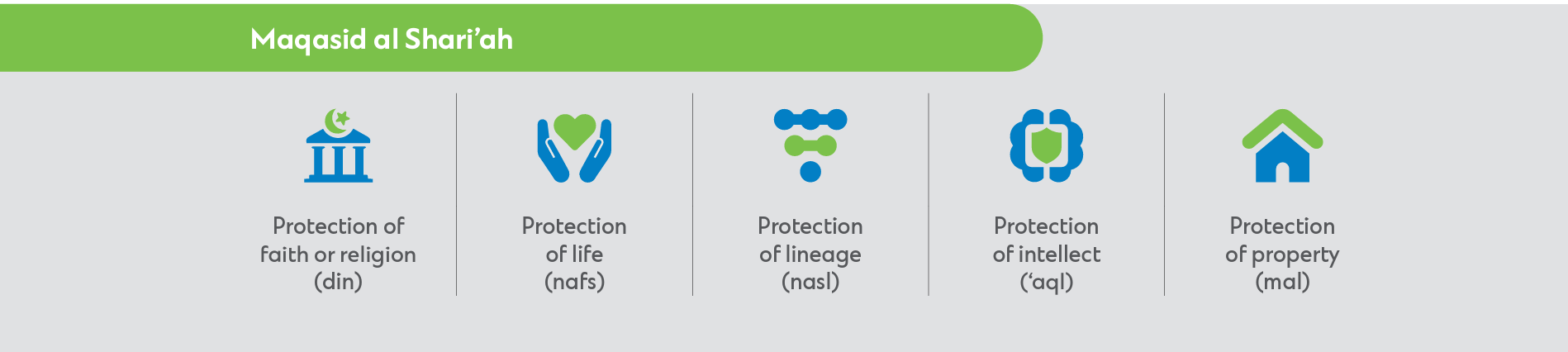
- Maps every answer to the five objectives of Maqasid al-Shariah
- Shows its sources for every response, no black boxes
When we started building Ask Ali, I assumed the biggest challenge would be the technology. It wasn't. It was discovering that fewer than 20 scholars sit on the boards of hundreds of institutions, and that a single fatwa issued years ago might still be the only thing standing behind a product that's been restructured multiple times since. The real problem that we identified was that knowledge is trapped in documents nobody can find, in languages not everyone reads, across jurisdictions that don't talk to each other. So we built Ask Ali, not to replace the scholars but to fix the plumbing. — Intesar Haquani, Chief Business Officer, Blade Labs
The result: scholars and compliance teams get everything they need to reach a conclusion in minutes instead of weeks, freeing them for the work that truly requires human judgment.
Join the early access → https://www.zeroh.io/ask-ali/beta
✍🏻 Deep Dives: Read More on the Blogs
Both announcements are backed by detailed research and analysis on our blog pieces. The full breakdown of the 81-Point Shariah Compliance Checklist - what each pillar covers, why structured preparation before SSB engagement matters, and how institutions can use the checklist as part of their compliance workflow.
Read the full article - The 81-Point Shariah Compliance Checklist Every Islamic Finance Team Should Be Using
Ask Ali was built to address a real and growing challenge in the industry. The data behind the scholar concentration problem, the risk of superficial Shariah compliance it creates, what technology should and should not do in this space, and why Malaysia's Capital Market Masterplan signals a turning point.
Read the full article - The Shariah Compliance Bottleneck Nobody Talks About (And How to Fix It)
💡 Why Impact Must Be the Measure of Innovation
A thread runs through everything in this newsletter; at Blade Labs, we acknowledge it directly: impact is the only honest measure of innovation.
The Islamic finance industry does not need more technology for technology's sake. It needs tools that solve real problems for real people and institutions. The Maqasid al-Shariah framework gives us a clear test: Does this innovation protect wealth? Does it preserve knowledge? Does it advance justice? Does it make ethical finance more accessible?If the answer is no, it does not matter how clever the technology is.
This is why we think about capacity building as inseparable from product development. When we build Ask Ali, we are not just building a research tool. We are trying to multiply the capacity of every Shariah scholar, every compliance officer, every product team working in Islamic finance. When we build the Compliance Checklist, we are trying to raise the baseline of preparation across the entire industry, not just for our customers.The Malaysian Masterplan's embrace of Maqasid al-Shariah as a governing framework is a signal that the industry is ready to hold itself to this standard. We welcome it. It is exactly the conversation we have been trying to start.
🗣️ Hear From Our CEO: Sami Mian at HederaCon 2026, Miami Beach📍
On May 4th, our CEO Sami Mian will be speaking at HederaCon 2026 at the Faena Forum in Miami Beach. Before founding Blade Labs, Sami served as Hedera's Head of Asia Pacific, working with enterprises including Nomura, Shinhan Bank, and LG Electronics to bring distributed ledger technology to production. Before that, he spent over 20 years in traditional finance at Citigroup and Deutsche Bank. That background is directly relevant to what we are building today.
ZeroH uses Hedera's infrastructure for verifiable credential and compliance frameworks, turning Shariah-compliant workflows into auditable, automated digital processes backed by DIDs and verifiable credentials anchored to Hedera's distributed ledger. HederaCon brings together enterprise DLT practitioners, leaders, and policy shapers. It is the right room for the conversation we want to have.
Follow our updates as we prepare for HederaCon. We will be sharing more on what we plan to bring to the conversation.
🛠️ What We Are Building Next
Some of the most meaningful work happens where it is needed most. We have been building toward something in Bangladesh that sits at the heart of why Blade Labs exists: using technology to create real economic opportunity for communities that the formal financial system has historically overlooked.
This project is deeply personal to our team, and it is rooted in the same Maqasid al-Shariah principles that guide everything we build: protecting livelihoods, advancing justice, and making ethical finance accessible to those who stand to benefit from it the most.
We will be sharing more alongside our partners on the ground in the coming weeks.
At the same time, we are building privacy-first AI infrastructure within ZeroH that lets institutions work with sensitive data without ever exposing it. Whether it is protecting a farmer's livelihood in Bangladesh or safeguarding an institution's most confidential records, the principle is the same: technology must serve as a guardian, not a gatekeeper.
Stay tuned for more insights into our upcoming projects.
Let's Talk - Whether you are navigating Shariah governance frameworks, exploring how technology can reduce compliance friction, or looking to launch regulated products faster, we would love to hear from you.
Visit our website 👉 - https://zeroh.io/
Get in touch with us 📩 - https://zeroh.io/contact